The Portland and Gresham Memory Care Blueprint: Why Local Context Matters
Schedule a TourCall: 503-492-6942Choosing a memory care facility for someone you love is one of the hardest decisions you’ll ever make — and in the Portland metro area, it’s made more complicated by a market flooded with polished brochures and impressive lobbies that don’t always reflect what’s happening on the floor at 2 a.m. Understanding the real factors to consider when looking for a memory care facility in Portland or Gresham, Oregon goes far beyond square footage and amenity lists.

The stakes are too high for surface-level research. Oregon operates under specific administrative rules that govern memory care separately from standard assisted living, meaning facilities aren’t all playing by the same rulebook. That regulatory complexity, combined with the Portland metro’s wide range of facility types and price points, creates a landscape where informed families consistently make better placements than those relying on marketing materials alone.
This guide cuts through the noise using four core pillars:
- Care Standards — staffing ratios, training, and medical access
- Local Logistics — proximity, transportation, and family visit patterns
- Cost and Legal Frameworks — contracts, Medicaid, and hidden fees
- Facility Design — safety features that actually support dementia-specific needs
What looks like a luxury hotel in photos may tell a very different story once you know what questions to ask — and where Oregon’s regulations draw the line.
The ‘Oregon Standard’: Navigating Specialized Care and Staffing
Understanding Oregon memory care regulations is the first place most families stumble — not because the rules are secret, but because the gap between what’s legally required and what’s genuinely sufficient is wider than most brochures suggest.
Start with a fundamental distinction: a standard Assisted Living Facility (ALF) and a facility with a Memory Care Endorsement are not the same thing. Oregon requires that any community housing residents with dementia obtain a specific endorsement under its Administrative Rules. That endorsement mandates secured or monitored environments, dementia-specific programming, and — critically — higher staff-to-resident ratios than standard assisted living. In practice, many families tour beautiful buildings without ever asking whether that endorsement is current and active. It should be one of your first questions.
Ratios matter most when no one is watching. The night shift is where understaffing most commonly hides. A facility might showcase its daytime team confidently, but a skeleton crew overnight — covering a memory care unit where residents wander, become disoriented, or need repositioning — is a serious safety concern. Ask specifically about overnight coverage, not just the facility’s general staffing philosophy.
Dementia-specific training is another area where state minimums and genuine competency diverge. Oregon sets a floor, not a ceiling. Ask whether staff have completed certifications beyond the baseline requirement — programs focused on behavioral de-escalation, communication techniques, and person-centered care.
The RN vs. On-Call Distinction
This is one of the most consequential details families overlook. Some facilities advertise “nursing availability” while meaning a Registered Nurse is reachable by phone — not physically present. There’s a significant difference between an RN on-site during key hours and one who responds remotely. For residents with complex medication needs or acute behavioral episodes, that gap in response time is meaningful.
As one local care analyst advises: “Ask: ‘What percentage of your staff are Certified Nursing Assistants (CNAs) versus Medication Aides?'” — the answer tells you a great deal about a facility’s real clinical capacity.
Questions to Ask Any Memory Care Facility:
- Is your Memory Care Endorsement current? Can I see documentation?
- What is your staff-to-resident ratio specifically on the night shift?
- What dementia training have your CNAs completed beyond state minimums?
- Is your RN on-site or on-call during evening and weekend hours?
Once you’ve assessed staffing and regulatory standing, the next practical layer involves geography — because where a facility sits relative to hospitals, highways, and your own front door shapes the quality of care in ways that are easy to underestimate.
Strategic Logistics: Proximity to Health Systems and Family Access
When families research how to choose memory care Portland, the conversation almost always starts with amenities and staffing ratios — and almost never starts with a map. That’s a mistake. Where a facility sits relative to hospitals, highways, and bus lines shapes the daily reality of care far more than any brochure ever will.
The 15-Minute Rule is a practical benchmark worth adopting: ideally, your chosen facility should sit within a 15-minute drive of a major health system capable of handling acute memory care emergencies. In the Portland-Gresham corridor, that means paying attention to proximity to the following:
- OHSU (South Waterfront/Marquam Hill) — Regional leader in neurology and dementia research
- Providence Portland Medical Center (Northeast Portland) — Strong geriatric and neurological services
- Legacy Mount Hood Medical Center (Gresham) — Critical for east-side facilities; the go-to hospital for emergency transitions for Gresham-area residents
Facilities in Gresham should specifically be evaluated for their proximity to Legacy Mount Hood, since emergency transport times directly affect outcomes during acute health events.
The I-84 Factor is equally real. Gresham sits at the eastern end of one of the Portland metro’s most congested corridors. A facility that looks close on paper can feel worlds away at 5:30 PM on a weekday. This matters because frequent family visits are the #1 deterrent against elder neglect, according to the Multnomah County Long-Term Care Ombudsman. Simply showing up — regularly and unpredictably — keeps care standards high.
Frequent, unscheduled visits aren’t just emotional support; they’re the most effective oversight tool a family has.
TriMet accessibility deserves a mention too. Not every family member drives, and not every staff applicant owns a car. Facilities near reliable MAX or bus lines tend to attract a broader, more consistent workforce — which quietly supports staffing stability.
The physical environment inside those facilities matters just as much as what surrounds them — and that’s exactly where the next piece of this evaluation comes in.
Design for Dementia: Evaluating the Physical Environment in the PNW
Once staffing ratios and hospital proximity are accounted for, the physical space itself deserves serious scrutiny. A beautiful lobby tells you very little. What matters is how the building functions for someone living with cognitive decline — and in the Portland and Gresham market, layout differences between facilities are significant enough to influence daily quality of life.
The floor plan is a therapeutic tool. According to Dementia Care Central, circular hallways prevent the frustration of hitting dead-ends, which directly triggers agitation — especially during late-afternoon “sundowning” episodes. Many newer West Hills and Gresham facilities are designed around a “Neighborhood” model, where small clusters of 10–15 residents share a defined living area, reducing the disorientation of navigating large, institutional corridors.
| Feature | Why It Matters |
|---|---|
| Circular hallways | Eliminates dead-ends that cause agitation and distress |
| Neighborhood pod layout | Reduces sensory overwhelm; feels more like home |
| Color-coded doors | Provides immediate visual landmarks for orientation |
| Shadow boxes with personal photos | Helps residents navigate independently to their own rooms |
| Secured covered courtyards | Enables outdoor access despite Portland’s rainy season |
That last point is non-negotiable in the Pacific Northwest. Oregon averages over 140 rainy days per year, and outdoor exposure supports circadian health — improving sleep cycles that are already disrupted by dementia. A facility without a covered, secure courtyard is effectively cutting residents off from daylight for months at a time.
When touring, look past the décor. Ask whether the outdoor space is usable in November. These environmental details don’t always show up in the brochure — and as you’ll see when comparing Gresham memory care costs across facilities, premium design features often come with a corresponding price tag worth understanding upfront.
Financial Transparency: Costs in the Portland Metro Market
Understanding pricing is where many families feel most overwhelmed — and where brochures are least helpful. Memory care billing is rarely a single monthly number. It’s a layered structure, and knowing each layer protects you from sticker shock later.
Base Rate vs. Level of Care Fees
Most Portland-area facilities charge a base rate that covers housing, meals, and general programming. On top of that sits a Level of Care (LOC) fee — a monthly surcharge tied to how much hands-on assistance your loved one requires. LOC assessments typically happen at move-in and are repeated every 90 to 180 days. What triggers an increase? Declining mobility, escalating behavioral symptoms, or increased help with activities of daily living like bathing and dressing. In practice, families often see total monthly costs rise $500–$1,500 within the first year as care needs evolve.
The Community Fee Reality
Before month one even begins, expect an upfront community fee — effectively a one-time admission charge. In the Portland metro market, this typically ranges from $3,000 to $6,000. It’s usually non-refundable, so negotiate terms in writing before signing anything.
| Cost Component | Typical Range (Portland Metro) |
|---|---|
| Base Monthly Rate | $5,500 – $8,500 |
| Level of Care Fee | $500 – $2,500/month |
| Community (Move-In) Fee | $3,000 – $6,000 (one-time) |
Medicaid, Spend-Down, and Oregon Project Independence
Oregon Project Independence and Oregon’s Medicaid program offer pathways for families who exhaust private savings — a process called spend-down. Always ask directly whether a facility holds Medicaid-certified beds, especially in Gresham, where availability varies significantly by community. Some facilities accept Medicaid only after a defined period of private pay.
One practical approach is to cross-reference any facility you’re considering against the Oregon DHS facility search tool, which confirms licensing status before you ever schedule a tour. That same database, as the next section covers, reveals something even more telling: the facility’s inspection history.
The ‘Analyst Check’: Using Public Records to Verify Safety
Once you’ve walked the hallways and reviewed the billing structure, it’s time to do what savvy consumers do before any major commitment: look at the paper trail.
How to Use the Oregon DHS Search Tool
The Oregon DHS licensing portal lets you search any licensed facility by name and pull its Statements of Deficiencies — official records of every cited violation following a state inspection. The process is straightforward:
- Visit ltclicensing.oregon.gov
- Search by facility name or city
- Select the facility and review its inspection history
- Download the most recent deficiency reports for closer reading
Red Flags Worth Pausing Over
Not every deficiency is disqualifying — minor paperwork citations are routine. However, recurring medication errors or repeated elopement incidents (a resident leaving unsupervised) signal systemic problems that a fresh coat of paint won’t fix. Pattern matters far more than a single isolated event.
The Ombudsman Is a Free Resource
The Multnomah County Long-Term Care Ombudsman independently investigates complaints against facilities. Reaching out before placement — not just after a problem arises — is a practical, underutilized step families often overlook.
A Note on Nutrition
Portland’s farm-to-table culture has influenced forward-thinking memory care communities. Ask specifically whether menus incorporate locally sourced ingredients and whether a registered dietitian oversees nutritional planning for residents with dementia-related appetite changes.
With these verification tools in hand, you’re ready to move toward a final, structured decision — which is exactly what the checklist ahead will help you complete.
Final Checklist: Making the Move in Portland or Gresham
Choosing memory care is one of the most consequential decisions a family will make. Cut through the uncertainty by working through these concrete steps before signing anything:
- Verify the license: Confirm the facility holds an RCF (Residential Care Facility) designation with a specific Memory Care Endorsement from Oregon DHS — not just a general assisted living license.
- Test the commute: Drive or ride the TriMet route during peak hours, and factor in I-84 traffic if you’re traveling from Gresham.
- Pull public records: Review the last 24 months of DHS inspection reports for complaint patterns and deficiency trends.
- Confirm the care philosophy: Ask directly whether staff practice Validation Therapy or the Best Friends Approach — then observe whether day-to-day interactions reflect it.
The right facility won’t just pass this checklist — it’ll welcome every question on it. Your loved one deserves a place that earns trust through transparency, not just polished marketing materials.
Key Factors To Consider When Looking For A Memory Care Facility In Portland Or Gresham Oregon Takeaways
- Care Standards — staffing ratios, training, and medical access
- Local Logistics — proximity, transportation, and family visit patterns
- Cost and Legal Frameworks — contracts, Medicaid, and hidden fees
- Facility Design — safety features that actually support dementia-specific needs
- OHSU (South Waterfront/Marquam Hill) — Regional leader in neurology and dementia research
Contact Us Today
We would love to provide you with more information on what our community has to offer!
SCHEDULE A TOUR TO COME SEE US ANYTIME
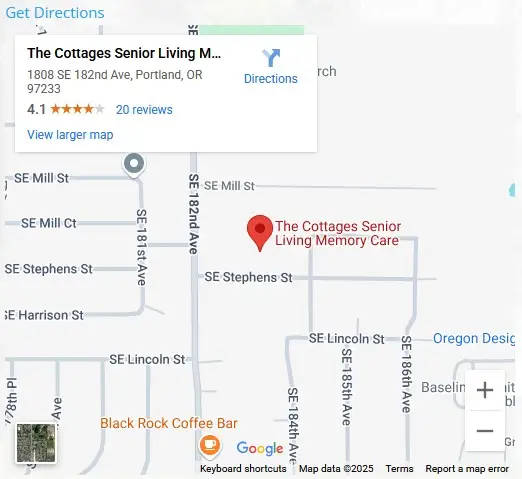
Located in a quaint neighborhood in Southeast Portland, we think you’ll love our community.
1808 SE 182nd Avenue
Portland, OR 97233